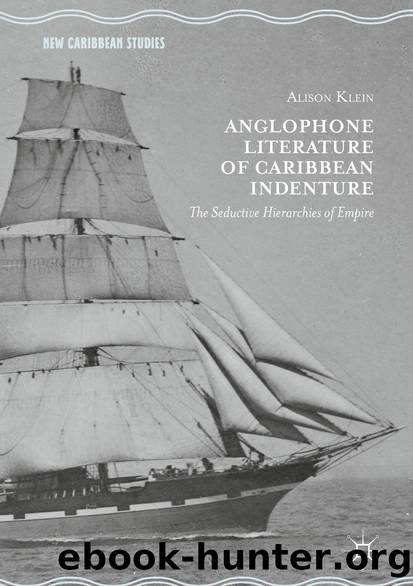
Anglophone Literature of Caribbean Indenture by Alison Klein
Author:Alison Klein
Language: eng
Format: epub
ISBN: 9783319990552
Publisher: Springer International Publishing
The Pagoda: Defying Colonial Categories
The Pagoda, by Patricia Powell, does not deal directly with indenture, but features a protagonist, Lowe, who smuggles himself on board a ship of Chinese migrants traveling to Jamaica under indenture. Lowe is born female but presents as male, and the novel refers to Lowe using masculine pronouns, and so this chapter does the same. Like The Counting House and The Promise, The Pagoda explores the relationship between a white man in power and the migrant that he sexually assaultsâin this case, Cecil, the captain of the ship upon which Lowe stows away, and Lowe. By contrast with The Counting House and The Promise, there is no sense that the characters in this novel represent their home nations, nor does Cecilâs treatment of Lowe act as an allegory for Britainâs treatment of China. Instead, the characters defy stereotypes, and their interactions with each other, while impacted by the broader dynamics of colonialism, are shaped more powerfully by the local: individual relationships, community norms, and shared experiences. The Pagoda thus acts as an example of fiction that condemns the abuses of colonialism and indenture without replicating the hierarchies underlying those systems.
The novel begins with Cecilâs death, which stuns Lowe, who is living as a shopkeeper in Jamaica. He reflects on their first encounter decades earlier and how their lives developed in the years that followed. Lowe bore Cecil a daughter, Elizabeth, now grown and married. Cecilâs death acts as a catalyst for Lowe to reevaluate his life, and he struggles to tell Elizabeth the truth: Lowe is Elizabethâs biological mother, and Cecil, not Lowe, is her father. As Lowe searches for a way to explain this to Elizabeth, he begins to shed the false identity that Cecil had developed for him and to recognize all of the ways that he and those around him push against the seemingly fixed categories of gender, ethnicity, and sexuality.
While Lowe never labors on the plantation, the suffering of those migrants who did acts as a backdrop for Loweâs own traumatic experiences. Lowe describes his time on the ship, which he shared with âstolen Chineseâ¦thin men spare as bonesâ¦piled in like prisoners and stowed tight with the chests of tea and silk, for sale to the highest bidder in the West Indiesâ (Powell 1998, 17). This description demonstrates the dehumanizing treatment of the laborers, who are packed onto the ship with the tea and silk, goods to be sold across the ocean. The words âstolenâ and âprisonerâ also indicate the involuntary nature of this migration, which is further emphasized when the Chinese migrants gather in Loweâs shop and tell tales of being kidnapped or tricked into signing a contract (Powell 1998, 43). The British system of Indian indenture certainly included its share of corruption, ill-treatment of laborers, and dehumanization, but in some ways, the Chinese system of indenture may have been worse, as it was a system of private profiteers as opposed to a state-run system. Walton Look Lai writes that the
Download
This site does not store any files on its server. We only index and link to content provided by other sites. Please contact the content providers to delete copyright contents if any and email us, we'll remove relevant links or contents immediately.
The Hating Game by Sally Thorne(19280)
The Universe of Us by Lang Leav(15083)
Sad Girls by Lang Leav(14431)
The Lover by Duras Marguerite(7908)
The Rosie Project by Graeme Simsion(6421)
Smoke & Mirrors by Michael Faudet(6198)
Big Little Lies by Liane Moriarty(5812)
The Poppy War by R. F. Kuang(5709)
The Shadow Of The Wind by Carlos Ruiz Zafón(5696)
An Echo of Things to Come by James Islington(4888)
Memories by Lang Leav(4806)
What Alice Forgot by Liane Moriarty(4642)
From Sand and Ash by Amy Harmon(4531)
The Poetry of Pablo Neruda by Pablo Neruda(4113)
The Tattooist of Auschwitz by Heather Morris(3850)
Ficciones by Jorge Luis Borges(3642)
The Rosie Effect by Graeme Simsion(3472)
Guild Hunters Novels 1-4 by Nalini Singh(3469)
THE ONE YOU CANNOT HAVE by Shenoy Preeti(3378)
